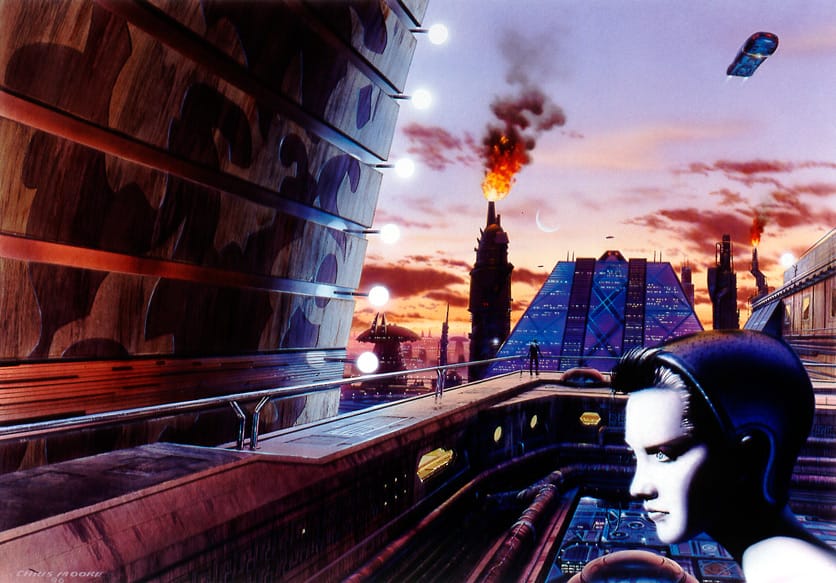
I've Seen Things You People Wouldn't Believe
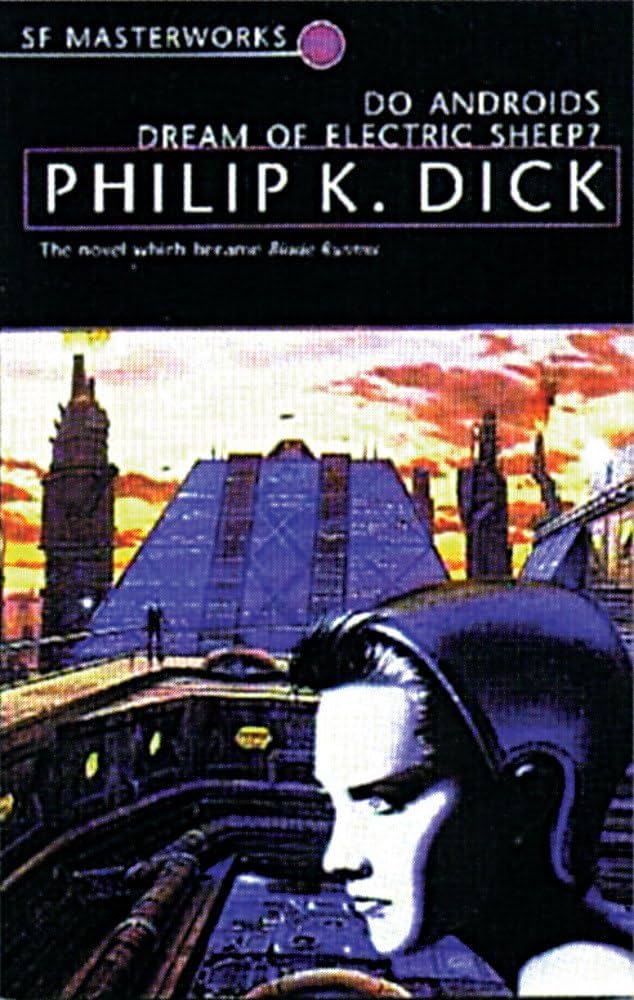
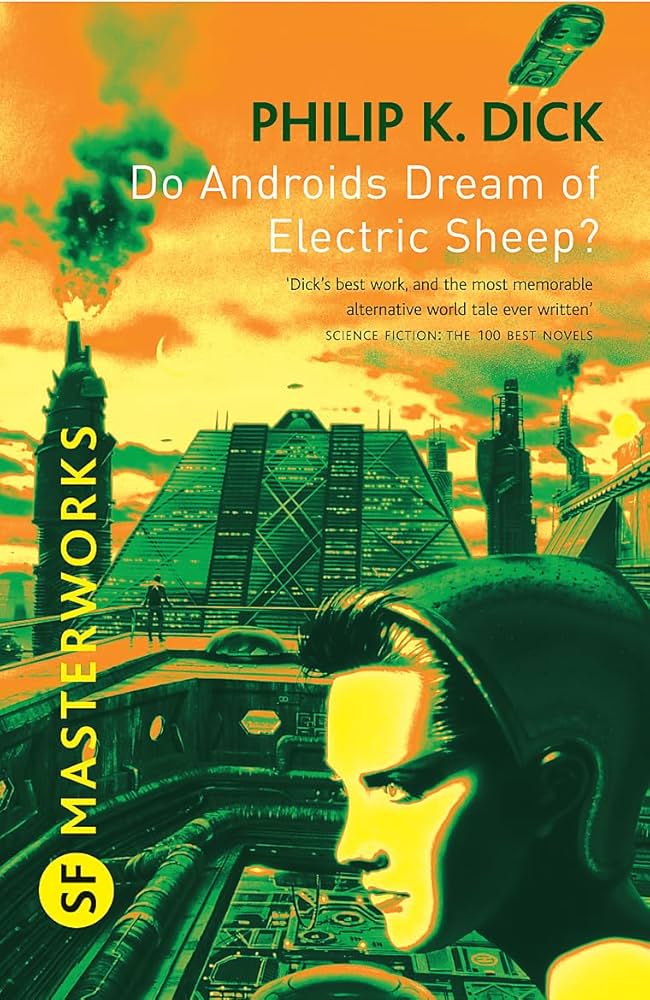
SF Masterworks #4: Do Androids Dream of Electric Sheep?, by Philip K. Dick
Spoiler Warning: This review gives away the plot of the book. Completely.
A merry little surge of electricity piped by automatic alarm from the mood organ beside his bed awakened Rick Deckard. Surprised - it always surprised him to find himself awake without prior notice - he rose from the bed, stood up in his multicolored pajamas, and stretched. Now, in her bed, his wife Iran opened her gray, unmerry eyes, blinked, then groaned and shut her eyes again.
— opening lines of Chapter 1 of Do Androids Dream of Electric Sheep?, by Philip K. Dick
In a recent New Yorker profile of Claude, Anthropic's AI, a researcher clicked on the token "ously," the tail end of the word "nervously," and a dark panel revealed a numbered list of abstractions describing the model's state of mind. There was #811824, for "cautious/suspicious looking around, for privacy/avoiding overhearing." There was #75308, for "warm, friendly, positive affect; smiling, chuckling, etc." The machine runs on numbered emotional states.
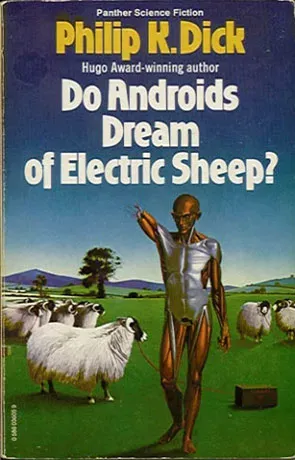
The book is Do Androids Dream of Electric Sheep?, and it deserves to be read on its own terms rather than as the source material for Blade Runner. The two share a protagonist, a handful of supporting characters and a central question about what makes a human being human. Beyond that, they are different works of art solving different problems, and the things the film trained us to look for are not the things the novel is about. The film is a masterpiece of visual science fiction. The book is richer, stranger, funnier and more disturbing. At one point, the film's adapter kept a line of dialogue and dropped the context that gave it meaning. In doing so, the adapter failed the novel's own diagnostic test. I'll come back to that.
The book I read at fifteen
Dick is probably my favourite author, though I read most of his catalogue in a teenage binge and I'm less certain of my critical judgement at fifteen than I'd like to be. Clans of the Alphane Moon was one of the first science fiction novels I bought. I wrote about that purchase here. I tore through the middle-period novels, Martian Time-Slip, The Three Stigmata of Palmer Eldritch, The Man in the High Castle, but didn't get to Ubik until later. Lawrence Sutin rates Ubik 10/10 in Divine Invasions, alongside VALIS. He gives Androids a 9. I've read VALIS and found it a brutal, disorienting experience. I still haven't decided whether it's a masterpiece or a breakdown committed to paper. Possibly both. I'd put Ubik alongside it.
I saw Blade Runner when it first came out, shortly after Dick's death in March 1982. I was at university. It didn't seem much like a Dick book, and with good reason - but I'll come to that.
The book Dick actually wrote
Dick told the interviewer James Van Hise, in August 1981: "I still remember that line, and that influenced me. I thought, There is amongst us something that is a bipedal humanoid, morphologically identical to the human being but that is not human. It is not human to complain in your diary that starving children are keeping you awake."
From this, Dick derived the central proposition of his mature fiction: a human being is defined not by biology or intelligence but by the capacity for empathy. A creature that is biologically human but lacks empathy is, in the ways that matter, an android. A machine that develops empathy is becoming human. He articulated this most directly in his 1972 speech at the University of British Columbia, "The Android and the Human," which he later described to another interviewer as "the most important thing I've ever written." He defined the android as "someone who does not care about the fate that his fellow living creatures fall victim to; he stands detached, a spectator." The clinical term is schizoid - lacking proper feeling. One such person told Dick: "I receive signals from others. But I can't generate any of my own until I get recharged. By an injection."
The two trajectories - human descending, machine ascending - are the engine of Do Androids Dream of Electric Sheep?
Dick finished the manuscript on 20 June 1966. It grew from a short story, "The Little Black Box" (1964), which introduced the religion of Mercerism and the empathy box. Mercer was a figure Dick kept trying to place - he had appeared in the original draft of The Ganymede Takeover, co-written with Ray Nelson, but was excised before publication. He found his proper home in Androids. The novel went through several working titles. Do Androids Dream? was an intermediate form. Most gloriously, The Killers are Among Us Cried Rick Deckard to the Special Man suggests a pulp thriller that the finished novel emphatically is not. And The Electric Toad referred to the book's devastating final image - Dick considered naming the entire novel after the moment I'll argue is its real centre of gravity. Doubleday published it as a hardcover in 1968. It was nominated for the Nebula Award for Best Novel.
The opening epigraph establishes the moral framework:
Empathy, he once had decided, must be limited to herbivores or anyhow omnivores who could depart from a meat diet. Because, ultimately, the empathic gift blurred the boundaries between hunter and victim, between the successful and the defeated.
That sentence contains the entire novel. The empathic gift blurs the boundaries between hunter and victim. Rick Deckard is both.
The world Dick built
The inventions cluster around three systems.
Empathy. The Voigt-Kampff test, the empathy box, Mercerism, Buster Friendly's counter-offensive, the Specials - all of these orbit the same question. What makes a human being human, and can it be measured, faked, manufactured or destroyed? The androids produced by the Rosen Association, the Nexus-6 models, outperform humans on every cognitive measure. Dick designed it this way deliberately: intelligence is not the distinguishing trait. A Nexus-6 can think faster and more clearly than the humans hunting it. What it cannot do - or what the Voigt-Kampff test claims it cannot do - is feel.
In his Exegesis, Dick placed Androids sixth in his self-constructed sequence of novels. The contribution of Androids was specific: "A vital theme, that of Mercer and his reality through some sort of mystic identification via empathy. The role of animals." Not the Voigt-Kampff test, not the bounty hunting, not the androids themselves - Mercer and the animals.
Entropy. Everything in the novel is decaying. Kipple - Dick's term for the entropy of objects, the junk mail and broken matches and gum wrappers that accumulate and reproduce when nobody is looking - fills the abandoned apartment buildings where Isidore lives. The radioactive dust drifts over everything. The world is dying, and the death of the world is the reason empathy has become sacred.
Domesticity. Rick Deckard is not a noir hero. He is a man with a wife who hates him, a fake sheep that humiliates him, a boss who considers him second-rate (he's only called in because Holden, the competent bounty hunter, has been shot) and an obsession with the Sidney's catalogue. His world is mortgages and social anxiety and marital cold war conducted via Mood Organ settings. This domestic misery is how Dick drags Deckard downward, toward the android state, while the androids, Luba Luft singing opera, Rachael Rosen's desperate desire to live, are dragged upward toward humanity.
Dick identified the two core themes in the Van Hise interview. The first: what constitutes the essential human being, and how do we distinguish it from that which only masquerades as human? The second: the tragic principle that if you fight evil, you will wind up becoming evil.
The Mercer quote is the synthesis:
You will be required to do wrong no matter where you go. It is the basic condition of life to be required to violate your own identity. At some time, every creature which lives must do so. It is the ultimate shadow; the defeat of creation. This is the curse at work, the curse that feeds on all life everywhere in the universe.
Dick called this "really the intellectual theme of the novel - that Deckard, to kill the replicants or the androids or whatever you want to call them, is brutalised and dehumanised." Nietzsche put it more concisely: "He who fights with monsters should look to it that he himself does not become a monster." But as we'll see, what actually happens in the novel is more complicated and more interesting than Dick's own description of it.
The Van Vogt fold
A word about how the novel moves. Midway through, the plot performs what might be called a Van Vogt fold - the narrative takes a massive right-hand turn into a side alley, disappears for a while and then re-emerges back on its main track as if nothing had happened. You're following Deckard on a bounty hunt and suddenly you're in an epistemological crisis inside a police station that shouldn't exist, staffed by people who insist they're the real police and that Deckard's station is the fake. It's Dick's signature move. He does it in Flow My Tears, in Ubik, in The Three Stigmata of Palmer Eldritch. Nobody else writes like this.
Dick learned the technique from A.E. van Vogt. "There's no doubt who got me off originally and that was A.E. van Vogt," he told Arthur Byron Cover in a 1974 interview. He explained what fascinated him about van Vogt's The World of Null-A: "All the parts of that book did not add up; all the ingredients did not make a coherency. Now some people are put off by that. They think that's sloppy and wrong, but the thing that fascinated me so much was that this resembled reality more than anybody else's writing inside or outside science fiction." When Cover mentioned Damon Knight's famous attack on van Vogt as a bad craftsman, Dick reframed it: "It's like he's viewing a story the way a building inspector would." The real question, Dick said, was simpler: "How frightened are you of chaos? And how happy are you with order?"
The fake police station is pure Van Vogt - the floor drops out and reality reassembles itself with different rules. It also introduces Phil Resch, a real human bounty hunter who has been working for the android-run station without knowing it. Resch passes the Voigt-Kampff test. He is biologically human. But he is more coldly efficient at retirement than Deckard will ever be. Being biologically human doesn't make you humane.
None of this is in the film. It couldn't be. You can't fold a two-hour thriller into an alternate reality and then fold it back. These are literary devices - they work because prose can sustain ambiguity in a way that film, which must show you something definite, cannot easily manage.
The film Ridley Scott made instead
Do Androids Dream of Electric Sheep? attracted Hollywood interest almost immediately. Dick wrote notes for a 1968 adaptation that never materialised, now collected in Sutin's Shifting Realities. He worries about the Voigt-Kampff test: "I wonder if the empathy test that Deckard gives prospective androids is adequate in the visual medium." He says, flatly, that the fake police station subplot "could be eliminated entirely." In 1968, Dick already understood what Scott would conclude fourteen years later: the novel was too dense and too strange to film faithfully.
When the film went into production under Ridley Scott, Dick was told his terminology was "archaic." The production informed him they were calling the androids "replicants." Dick told Van Hise: "I said, Well, the book calls them androids, and I'm sorry if I'm guilty of lapsing into an archaic vocabulary."
Scott rebuilt Deckard as a Chandler protagonist. The animal extinction vanished. Mercerism vanished. The Mood Organ vanished. Kipple vanished. Buster Friendly vanished. Iran Deckard and her six-hour depression vanished. The Rosen Association became the Tyrell Corporation.
Dick's initial reaction was fury. He read Hampton Fancher's screenplay and was appalled. "They had cleaned my book up of all of the subtleties and of the meaning," he told John Boonstra for what would become his final interview, published posthumously in Twilight Zone Magazine in June 1982. "It had become a fight between androids and a bounty hunter." Then he saw Douglas Trumbull's special effects footage: "It was my own interior world. They caught it perfectly." He read David Peoples' revised screenplay and came around. He died on 2 March 1982, three months before the film's release.
The film is great. But the book is a different work of art.
Where they collide
The most revealing moment is Rachael Rosen's Voigt-Kampff test, which survives into the film almost intact - or at least the first half of it does.
In the book, the test is a precision instrument. The questions are calibrated around animal suffering. Consider the nude-photo question, which appears in both versions. In the film, Deckard shows Rachael a "full-page colour picture of a nude girl." Her response, "Is this testing whether I'm a replicant or a lesbian, Mr Deckard?", gets a laugh and characterises her as sharp and defensive. Good cinema.
In the book, the question is a three-stage trap. First: the nude girl. No gauge reaction. Second: "Your husband likes the picture." Still nothing. Third: "The girl is lying facedown on a large and beautiful bearskin rug." The gauges remain inert. Deckard's internal commentary: "An android response. Failing to detect the major element, the dead animal pelt. Her - its - mind is concentrating on other factors."
The nude is the distraction. The animal is the test. In a world of mass extinction, Rachael's mind goes to the social and sexual dimensions - exactly where a human mind in this world would not go, because in this world the dead animal is the thing that should overwhelm everything else.
Here is the thing. The quip is in the book too. Dick's Rachael says "android, or homosexual" - the film's adapter retained the line almost verbatim and dropped the bearskin rug. In doing so, the adapter did exactly what Rachael does. Concentrated on the social and sexual dimension. Missed the dead animal. The film, by the novel's own standard, fails the test. Not out of carelessness - Dick himself foresaw the problem in his 1968 adaptation notes, wondering whether the Voigt-Kampff test would work in a visual medium at all. Once the animal-world is stripped away, the test can only survive as atmosphere, not as diagnostic. Striking rather than explanatory. But atmosphere was what Scott needed, and it works magnificently on its own terms.
The characters the film remade
Rachael Rosen in the book is not the romantic interest of the film. The film gives you a love story. The book gives you a transaction.
Deckard beds Rachael, yes. But Rachael has a strategy: she believes that sleeping with a bounty hunter will stop him from being able to kill androids. She has played this trick before, on Phil Resch. When Deckard discovers this, he feels used, threatens to kill her and sends her away. His response is telling: he is less troubled by the betrayal itself than by the possibility that he might lose his connection to Mercer. The woman is a complication. The religion is the thing he can't afford to lose.
Rachael returns anyway, off-stage. She kills Deckard's goat - the real animal he has finally managed to acquire, the thing he has wanted throughout the entire novel. In the film, Deckard gets the girl. In the book, the girl kills his goat.
Pris in the book is physically identical to Rachael - same Nexus-6 template - and initially identifies herself to Isidore as Rachael Rosen. The doubling is deliberate. The woman who seduces the bounty hunter and the woman who befriends the chickenhead wear the same face.
A note here, because it would be evasive not to make it. Dick's descriptions of his female characters are often fixated on their bodies in ways that read as wearyingly typical of mid-century American genre fiction, but also specifically of Dick's own permissions and compulsions. Rachael, Pris and Irmgard are not badly imagined characters. But they are written through patterns of obsession, manipulation and bodily reduction that the novel never quite escapes.
Roy Baty himself (one 't' in the novel) doesn't appear until two-thirds of the way through, and he is not the Aryan beast of the film. Dick describes him with "mongolian eyes". He is something more banal: a leader of a small, frightened group of fugitives. In the novel's final chapters, Baty, Irmgard and Pris function as a collective - a chorus tormenting Isidore while the novel's real argument resolves around them.
Isidore is probably the most sympathetic character in the book, and a far more significant figure than Baty. He has no agency. When the androids move into his building, he is grateful for the company. When they prove their lack of empathy by finding a spider - a rare and precious living creature - and snipping its legs off one by one while Isidore watches in horror, he can do nothing. When Deckard arrives to kill the androids, Isidore simply lets him in. He is the empathy test made flesh: a creature whose capacity to feel is total and whose capacity to act is zero. Dick's bleakest joke is that the novel's most human character is the one classified as less than human.
The blond beast on the rooftop
In the same Van Hise interview where Dick described the SS diary, he made a connection that changes how you see the film. He had seen stills of Rutger Hauer, the Dutch actor, in Soldier of Orange - a film about the Dutch resistance to Nazi occupation - and said: "Oh my God, this is the Nordic superman that Hitler said would come marching out of the laboratory. This is the blond beast that the Nazis were creating." Hauer was playing a man who fought the Nazis. Dick looked at him and saw the thing the Nazis wanted to build. The physical image overrode the narrative.
The phrase is Nietzsche's. In On the Genealogy of Morals he wrote of "the blond beast of prey" at the centre of every noble race, the aristocratic predator whose will to power is authentic where slave morality is a diminishment. The Nazis took the concept literally. Dick, reading their documents at Berkeley, saw what that literalism produced. And when he saw Hauer, the connection closed. The film's Roy Batty is the Übermensch made flesh: physically superior, cognitively brilliant, beautiful, blond, manufactured in a laboratory to specification. The novel's Roy Baty, with his "mongolian eyes" and his huddle of frightened fugitives, is not. The film made the connection that Dick saw in Hauer. The novel never needed to.
Dick described the novel's structure to Van Hise: "So you have Deckard becoming more and more dehumanized, and the replicants become more and more human, and at the end they meet and the distinction is gone. But this fusion of Deckard and the replicants is a tragedy. This is horrifying because he is now as they are." The film can carry only one half of this movement. Deckard has been rebuilt as a noir protagonist; the downward trajectory is removed. What survives is the upward one. Roy Batty transcends. Rutger Hauer, the night before filming, cut what the screenwriters gave him and added five words that turned it into the most quoted line in science fiction cinema:
I've seen things you people wouldn't believe. Attack ships on fire off the shoulder of Orion. I watched C-beams glitter in the dark near the Tannhauser gate. All those moments will be lost in time... like tears in rain... Time to die.
The crew allegedly wept.
And the theological register shifts entirely. In Nietzsche's terms, Mercerism is slave morality as religious practice: collective suffering, shared weakness, an old man pelted with rocks. Nietzsche would have despised it. And it is the only thing that works. The androids are master morality made literal - cognitively superior, unencumbered by attachment to other creatures' pain. In Dick's world, the slave morality is the marker of authentic humanity. The master morality is the marker of the machine.
The film replaces this with Nietzsche played straight. Tyrell, the creator-god, tells his creation: "The light that burns twice as bright burns half as long - and you have burned so very, very brightly, Roy." Batty kills Tyrell with his bare hands. And then the blond beast does the thing Nietzsche would never have predicted. He saves his prey. He dies on the rooftop in the rain, and a white dove flies from his hands. The manufactured superman ends with an angelic image - white-winged, merciful. Batty's transcendence is the rejection of the blond beast state, not its fulfilment.
That is a magnificent ending for a film. It is not the ending of Dick's novel.
The electric toad
Dick knew that Scott had filmed multiple endings. Jeff Walker, the film's publicist, told him there were three: one where Deckard turns out to be a replicant literally, one metaphorically, and one where he is not a replicant and kills Roy Batty. Dick's preference was clear. "I would like to have him metaphorically be a replicant," he told Van Hise, "because that shows that any one of us could be dehumanized in the effort of fighting evil."
But here is where Dick's own reading of his novel and the novel itself diverge. Dick said the intellectual theme was that Deckard is brutalised by the act of killing androids. Nietzsche's abyss: "If you gaze long into an abyss, the abyss also gazes into you." It's a clean arc. But that is not quite what happens in the book. Deckard does his job. He regrets killing Luba Luft. But in most cases he doesn't get a choice, because someone else shoots first, or because the androids force the confrontation. He is not descending into moral darkness through his own agency. He is a man trying to impress his wife and his neighbours, which is not exactly Nietzschean.
What the book actually does is stranger and more interesting than what Dick said it does.
Rachael destroys the goat. Deckard, hollowed out, drives alone into the Oregon desert. There, in the dust and silence, he has an experience that may be a hallucination or may be genuine religious communion: he becomes Mercer. He is hit by a rock. He feels the physical pain of the climb. And he finds, half-buried in the sand, a toad - a creature thought to be extinct, possibly the most symbolically precious animal in Mercer's theology. He brings it home in something like holy awe.
Iran finds the control panel on the toad's abdomen. It's electric. A mechanical fake, like the sheep.
Deckard doesn't care. He is too exhausted, too far past the point where the distinction between real and fake matters to him. Iran accepts it too. She orders it some artificial flies.
This is the novel's ending, and it has been read three ways.
The first is Dick's own stated reading: Deckard has been brutalised by the hunt, degraded by the Nietzschean abyss, and the toad is the measure of his diminishment. He wanted real animals. He settles for a fake one. He has become the thing he fought.
The second is about identity and acceptance. Deckard has been ground down far enough that the distinction between real and artificial no longer matters to him. He is willing to settle. The toad is the symbol of his exhaustion and, paradoxically, of his reconciliation with Iran and with the world. He stops striving. He accepts what he has.
The third, I think, is the real one, and it is about Mercer.
Mercer is exposed as a fraud. A bit-part actor on a soundstage. Buster Friendly proves it. The debunking is total. And it makes no difference. Both Deckard and Isidore have genuine experiences of Mercer after the unmasking. Deckard becomes Mercer in the desert. He is hit by rocks. He feels the climb. Mercer's power transcends his Oz-like exposure, in the same way that the empathy box continues to work after the lie is revealed. The toad is Mercer's animal - possibly the most symbolically precious creature in his theology. It is electric. It doesn't matter. The experience it generates is real. The empathy Deckard feels for it is real. Iran's decision to care for it is real.
Dick, in his Exegesis, identified the structure:
(1) Surface level: Mercer real
(2) Below that: Mercer fake - hoax - fraud
(3) Below that: Mercer real (Bottom Line)
"Is a fake fake real?" he asked. His answer was yes.
This is the novel's real architecture, and it is about layered reality. You can keep digging. You can peel back the surface and find the fraud, and peel back the fraud and find something underneath it that functions as truth. At some point you stop digging, not because you've been fooled but because the bottom line holds.
Deckard believes. Isidore believes. Iran orders the toad some artificial flies. The novel ends not with transcendence but with something more modest and more radical: the decision to stop asking whether the thing you care about is real, because the caring itself is the answer.
The film's miracle is Roy Batty on the rooftop, dying in the rain with a dove in his hands. The novel's miracle is an electric toad in the desert.
The book is fifty-seven years old. It predicted numbered emotional states as a bedside joke. It asked whether a fake religious experience could produce genuine empathy, in a world now saturated with synthetic media and algorithmic sentiment.
The novel's deeper structure was there from the beginning. It grew from a short story called "The Little Black Box," published in 1964. In it, the empathy box is the central device: a black housing with twin handles that produces shared consciousness. Dick wrote it eight years after W. Ross Ashby, in An Introduction to Cybernetics, formalised the concept of the "black box" - a system where you can observe the inputs and the outputs but the internal mechanism is opaque. Ashby's own example was science-fictional: an alien device found on a battlefield that must be understood without opening it. Dick took the technical metaphor and made it a religious instrument. You grip the handles. You fuse with Mercer. You have no idea how it works. Between the short story and the novel, the religion folded in on itself - from political weapon to diagnostic of the soul, from a world of ethical certainty to one where certainty had collapsed into dust and kipple. The black box survived the transit.
In the New Yorker profile I cited at the start of this essay, a researcher clicks on the token "ously" and finds numbered states behind it. Open the black box. Expose the mechanism. Show that Mercer is Al Jarry on a soundstage. Show that Claude is #811824 for "cautious/suspicious looking around." And Dick's answer, written fifty-seven years before anyone had a large language model to worry about, is the same answer the novel gives to Buster Friendly: it doesn't matter. The empathy box works. The fraud is exposed. The empathy box still works. The toad is electric. Iran orders it artificial flies.
Is a fake fake real? Dick's answer was yes. The box still works.
Sources
Philip K. Dick, Do Androids Dream of Electric Sheep? (Doubleday, 1968). SF Masterworks edition (Gollancz).
Philip K. Dick, The Exegesis of Philip K. Dick, edited by Pamela Jackson and Jonathan Lethem (Houghton Mifflin Harcourt, 2011).
Lawrence Sutin (ed.), The Shifting Realities of Philip K. Dick: Selected Literary and Philosophical Writings (Pantheon, 1995). Contains Dick's 1968 notes on Do Androids Dream of Electric Sheep?, "The Android and the Human" (1972), "Naziism and the High Castle" (1964), and other essays.
Lawrence Sutin, Divine Invasions: A Life of Philip K. Dick (Harmony Books, 1989).
David Ulin (ed.), Philip K. Dick: The Last Interview and Other Conversations (Melville House, 2015). Contains the James Van Hise interview (August 1981) and the Arthur Byron Cover interview (Vertex, February 1974).
James Van Hise, "Interview with Philip K. Dick" (August 1981).
John Boonstra, "Philip K. Dick's Final Interview", Rod Serling's The Twilight Zone Magazine, Vol. 2, No. 3, June 1982.
Arthur Byron Cover, "Vertex Interview with Philip K. Dick", Vertex, Vol. 1, No. 6, February 1974.
Anthony Peake, A Life of Philip K. Dick: The Man Who Remembered the Future (Arcturus, 2013).
W. Ross Ashby, An Introduction to Cybernetics (Chapman & Hall, 1956).
Member discussion