SF Masterworks #2: I Am Legend, by Richard Matheson
Spoiler Warning: This review gives away the plot of the book. Completely.
On those cloudy days, Robert Neville was never sure when sunset came, and sometimes they were in the streets before he could get back.
— I Am Legend, Opening lines of Chapter 1.
I Am Legend was Richard Matheson's first novel, published in 1954 at the start of a long and successful career. He went on to publish other successful novels, many of which have been filmed with various degrees of success - The Shrinking Man (filmed as The Incredible Shrinking Man), Hell House, Stir of Echoes, What Dreams May Come - as well as a large number of short stories and television scripts, including well-known Twilight Zone episodes such as Nightmare at 20,000 Feet. Many would pick that one as their favourite; my own choice, And When The Sky Was Opened, was also based on a Matheson short story ("Disappearing Act"), though by the time Rod Serling had finished with it, little of the original remained.
The novel is one of those foundational texts that's been so thoroughly strip-mined by subsequent fiction that reading it now feels oddly like encountering a cover version of itself. Every zombie film, every post-apocalyptic survival story, every tale of lone survivors fortifying suburban homes against the shambling hordes owes Matheson a debt that mostly goes unpaid.
The novel's power lies in its refusal to let this become mere adventure. Neville is not a hero grimly doing what must be done. He's a traumatised, increasingly alcoholic man whose survival has become its own kind of death. Matheson gives us long passages of research - Neville, with no scientific training, tries to understand the plague through library books and microscopes, working out the biological basis for vampirism with the dogged persistence of a man who needs something, anything, to structure his days. The prose style serves this perfectly: artisanal rather than deliberately artistic, professional in a journalistic way - flat, direct, workmanlike. The horror of the setting plays against the plainness of the language, and the contrast is remarkably effective. There's no Gothic atmospherics here, no purple passages about the encroaching darkness. Neville repairs his generator, strings garlic, drinks whisky, and kills vampires, and Matheson describes all of it in the same matter-of-fact register. The mundanity is the point.
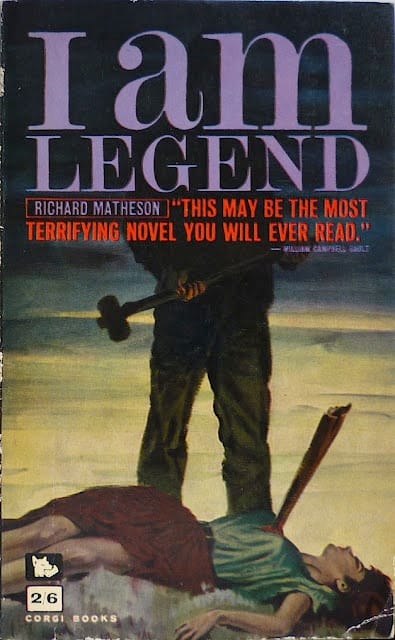
Through flashbacks - and one devastating late-night confession - we learn how Neville lost his wife and daughter to the plague, and how his wife returned from the dead, forcing him to stake her himself. That's the scene the Corgi cover depicts, sensationalised into pulp titillation but not, as it turns out, invented. Among the vampires who gather nightly is Ben Cortman, a former friend and neighbour, now reduced to shouting abuse outside Neville's window, trying to lure him out to be devoured. There's something of Cheever's The Swimmer in this - the same queasy recognition that the people you thought you knew have turned on you, that the suburban social fabric was always more fragile than it appeared.
Stephen King, whose debt to Matheson is considerable, put it well:
He fired my imagination by placing his horrors not in European castles and Lovecraftian universes, but in American scenes I knew and could relate to. "I want to do that," I thought. "I must do that."
King took both lessons - the modern American setting and the careful, flattened craft - and built a career on them. Where King sometimes comes unstuck is when his material turns visceral or nasty for its own sake. Matheson never does that.
The novel was a success, despite never quite winning over the Campbellian constituency. Damon Knight, forever a master of missing the point, said in an essay entitled "Half-Bad Writers":
The book is full of good ideas, every other one of which is immediately dropped and kicked out of sight. The characters are child's drawings, as blank-eyed and expressionless as the author himself in his back-cover photograph. The plot limps.
The turning point comes when Neville encounters Ruth, apparently another survivor. Their tentative connection - his desperate hope, her strange reluctance - builds toward the novel's devastating revelation. Ruth is not what she appears. She represents a new society of infected humans who have learned to control their condition, who have built a civilisation in the ruins. To them, Neville is not humanity's last hope. He is a monster, a daylight killer who murders their sleeping kin. He is the legend mothers tell their children about, the terror that stalks while they rest.
The title's meaning inverts everything. The snark, it turns out, is a boojum. While Neville has been holed up in his suburban fortress, methodically working out the science, the story he thought he was in has inverted around him. He isn't devoured by the vampires. He's devoured by the narrative. He realises, in his final moments, that he has become to this new humanity what Dracula was to the old: a figure of nightmare, an impossible creature from a dead world. The vampires are not the monsters of this story. He is.
Matheson wrote the template for modern horror's interest in perspective and moral inversion, the recognition that monstrosity is often a matter of which side of the barricade you're standing on. It's a slim book, barely a novella, and it contains more genuine thought about what survival means - what it costs, what it makes of us - than most thousand-page epics manage.
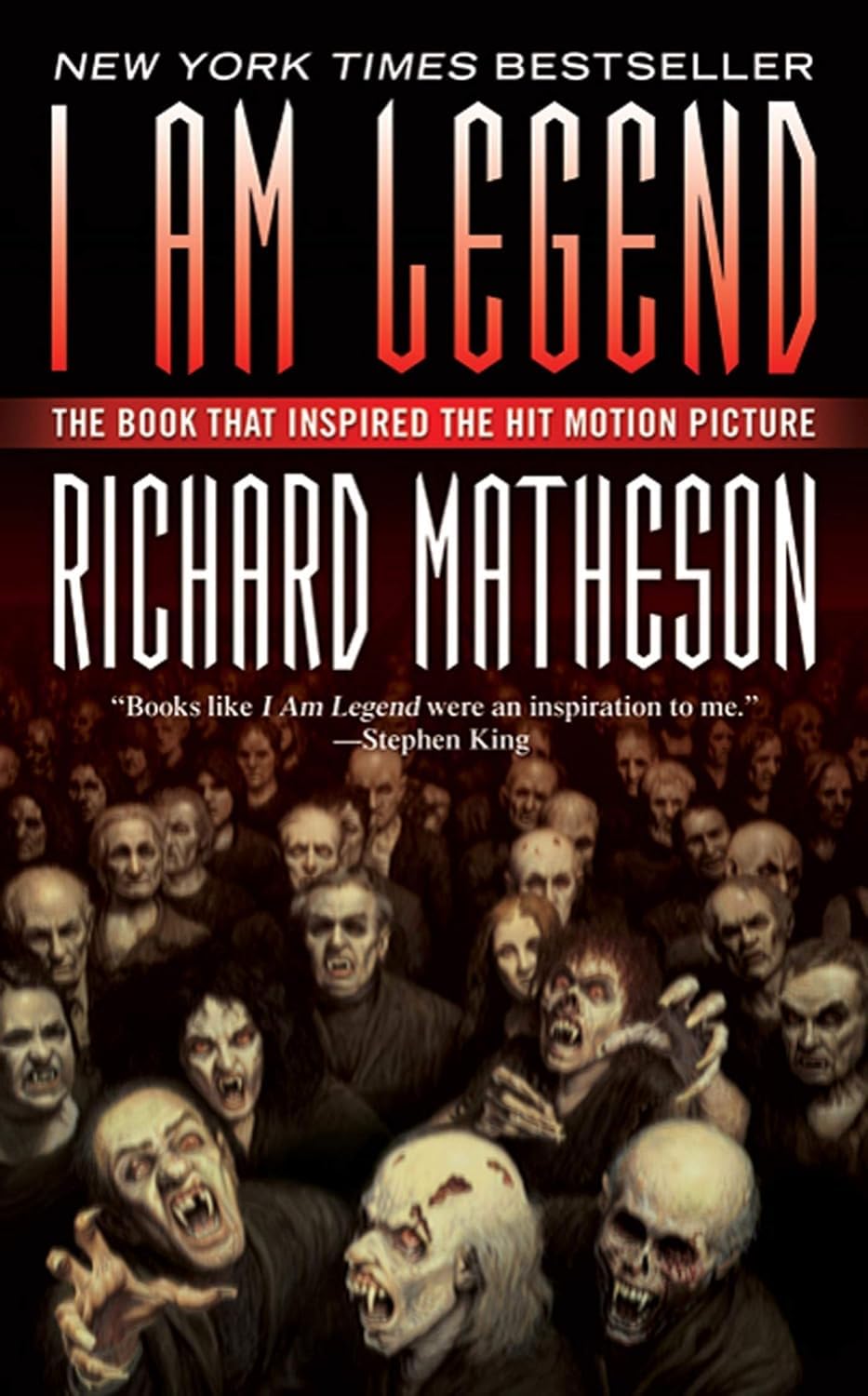
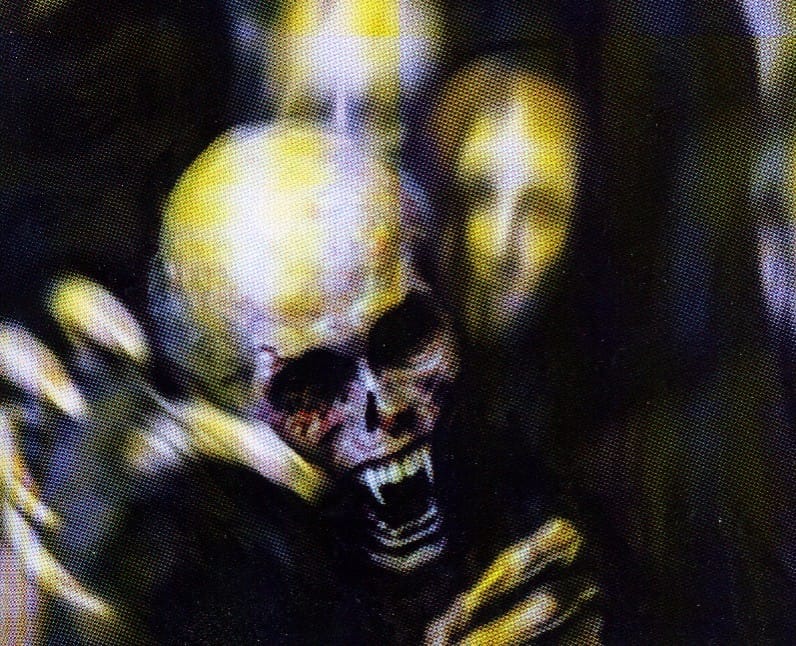
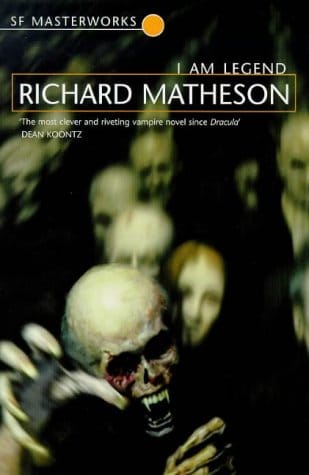
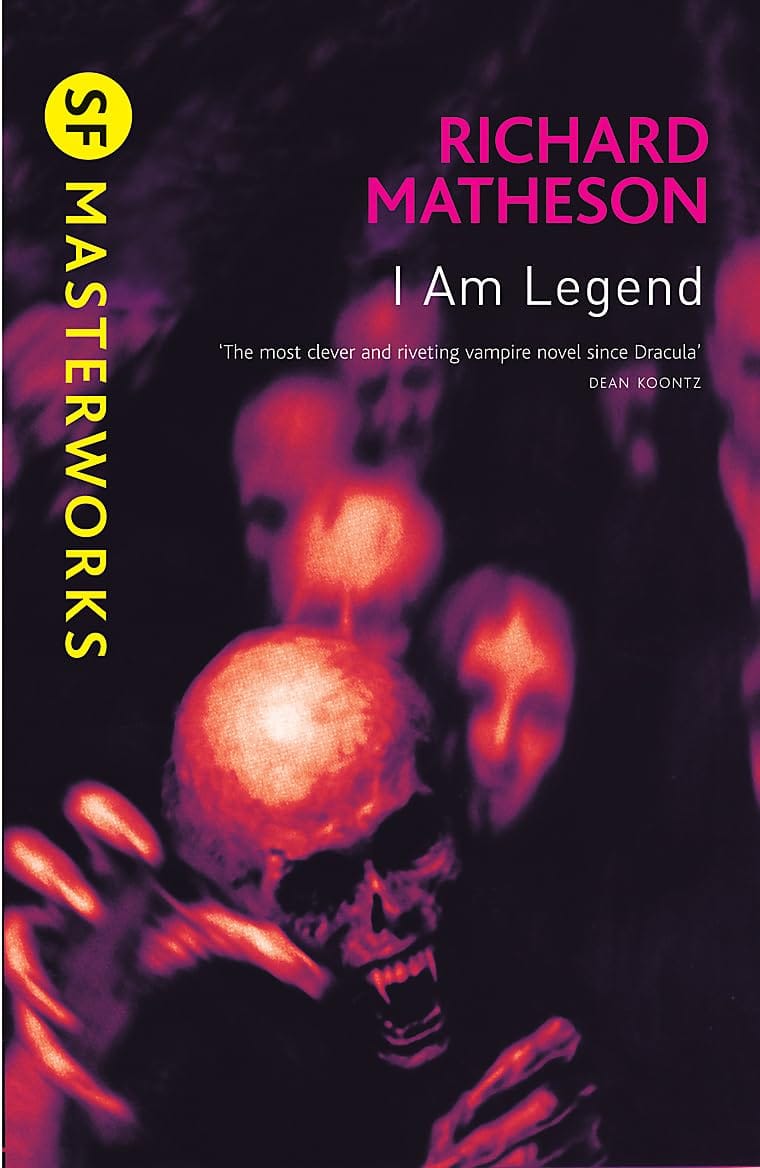
The cover of the current SF Masterworks edition is "based on an illustration by Jim Thiesen". The previous black-spined edition was fully credited to Thiesen, which means that whoever lazily slammed said image through a crappy filter - like most of the early yellow-spined Masterworks editions - is taking an awful lot of credit. That cover is in turn merely a detail of Thiesen's original art, produced (but even then edited and inverted) for the US Tor edition. In 2011, Thiesen talked about how unhappy he was about the progressive erasure of his original work.2 I don't blame him. The entire illustration was eventually used by Tor for their edition to accompany the release of the 2007 film.
The introduction on the yellow edition is by Graham Sleight and is relatively brief, as many of the Masterworks introductions are. As you might expect, you can find a more expansive introduction, in this case by Joe Hill, within the Folio Society edition, beautifully illustrated by Dave McKean. As a completist and a madman, I have all of them, but if you have the money, buy the Folio.
1 Matheson, interviewed, noted: "I met George Romero who held up his hands in mock defense and said, 'It didn't make any money!' I ran across his film on TV one night and thought, When did they make my novel into a film again?" See the full interview.
2 The entire I Am Legend Archive website is worth exploring - a comprehensive resource on the novel and its many adaptations.
Member discussion